
The Creative Process: Finding the human truth behind great ideas
Q&A with Nwabisa Tolom, Creative Director at TBWA Hunt Lascaris
Nwabisa’s creative journey has taken her from Joburg to New York, San Francisco, Amsterdam and back again, shaping the way she thinks about ideas, craft and culture along the way. Now working as a Creative Director at TBWA and on big brands like Savanna, she brings a global perspective to the work, grounded in an understanding of human behaviour and the uniquely textured humour of South Africa. In this conversation, she reflects on how working across cultures has shaped her approach to creativity, what separates a good copywriter from a great one, how she chooses directors and collaborators, and why the ideas that scare you a little are often the ones worth fighting for.
Over the past decade, Nwabisa has worked across some of the world’s most competitive creative environments, collaborating on projects for brands like Adidas, Netflix and Optimum Nutrition, while learning firsthand how different markets approach strategy, storytelling and craft. From studying film in New York to shaping campaigns across Europe and the US, those experiences have sharpened her belief that the strongest ideas are the ones rooted in something fundamentally human.
“South Africa is a uniquely fertile market for communication. The rigid rules that often govern agencies in Europe and the U.S. simply do not hold the same power here.
Q: You’ve worked across South Africa, New York, San Francisco, and Europe. When you’re handed a new brief now, what’s the first thing you instinctively look for, regardless of market?
Nwabisa: Working globally sharpened my respect for strategy and craft, but it also taught me that the strongest ideas don’t travel because they’re loud, they travel because they’re true.
Markets differ. Platforms evolve. But people are people. We want connection, recognition, belonging. When a brief taps into something fundamentally human, geography becomes secondary.
So my first question is always: What is the real thing we’re trying to say, and why should anyone care?
Once you find that, the work tends to reveal itself, no matter where you are in the world.
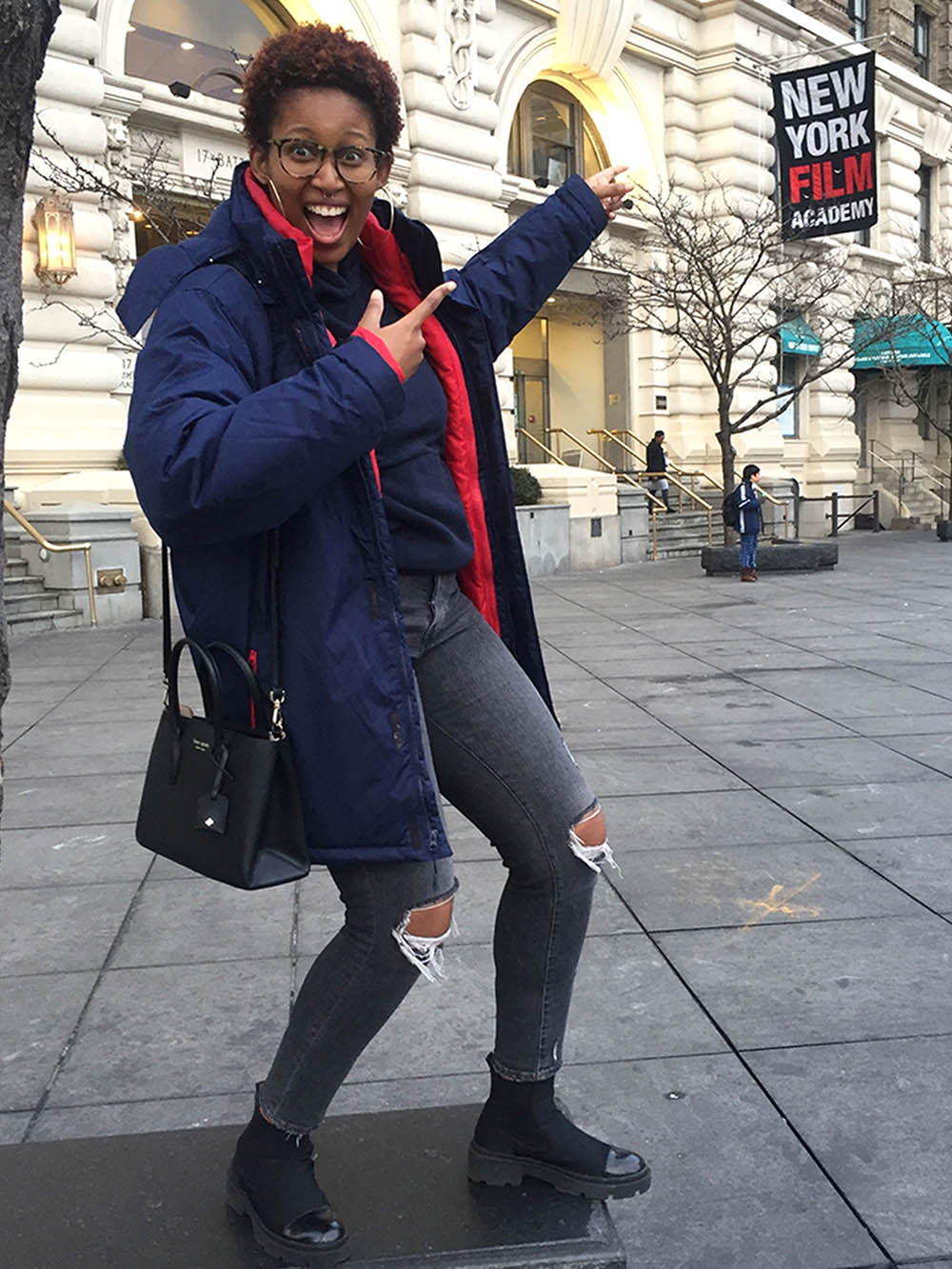

L: After a few years in the ad game in SA, Nwabisa moved to New York to study film. She graduated from New York Film Academy in Screenwriting and Directing. Then she blinked and time had snowballed into 10 years abroad.
R: Nwabisa on set of my experimental short film, ‘Burnt Black’ which she made in collaboration with a group of creatives. The experience lead to Nwabisa going on to directing music videos.
Q: In the simplest terms, what is a copywriter, and what separates a good one from a great one?
Nwabisa: A copywriter is a translator of human behaviour. We observe how people live, what they laugh at, what they fear, what they long for, and we turn those observations into something that moves them.
If you can land an idea in a way that feels both inevitable and surprising, you’re not just writing, you’re shaping perception. And that’s the real job. A good copywriter writes beautifully. A great one understands people deeply enough to write simply.
Q: When do you know you’ve really nailed an idea?
Nwabisa: You feel it before you can explain it. There’s a quiet certainty that settles in the room, when everyone has that knowing smile while their eyes dart around to each other searching for if everyone else feels it too.
I remember that feeling when my CD partner, Kevin Radebe, and I presented the idea for Savanna’s ‘We Outside’ campaign, specifically the ‘Mozzie‘ film, to our ECD Steph van Niekerk. It had been a tough few weeks trying to create something distinct enough to launch the new 500ml can while still sounding unmistakably Savanna.
But that Friday night, on that call, we all knew.
It scared us a little. The expressions, ‘wtf’ and ‘are we sure?’ were thrown around a few times. Which is usually a very good sign.
Savanna ‘Mozzies’
Savanna ‘Mozzies’ (Director’s Cut) was awarded a Best in Craft to Zee Ntuli from Darling Films for Direction in September 2025.
This was the judge, Director Thina Zibi’s comment:
“This is a brilliant example of playful, culturally tuned-in storytelling. Firstly, I loved the clever placement of the Savanna logo in the real outdoors! A small detail but big statement. I enjoyed that this world of Savannah was kept realistic and not overly curated, a breath of fresh air from how we know the brand, while still maintaining its humorous and playful voice. (…) A spot that’s smart, funny, and exquisitely crafted.”
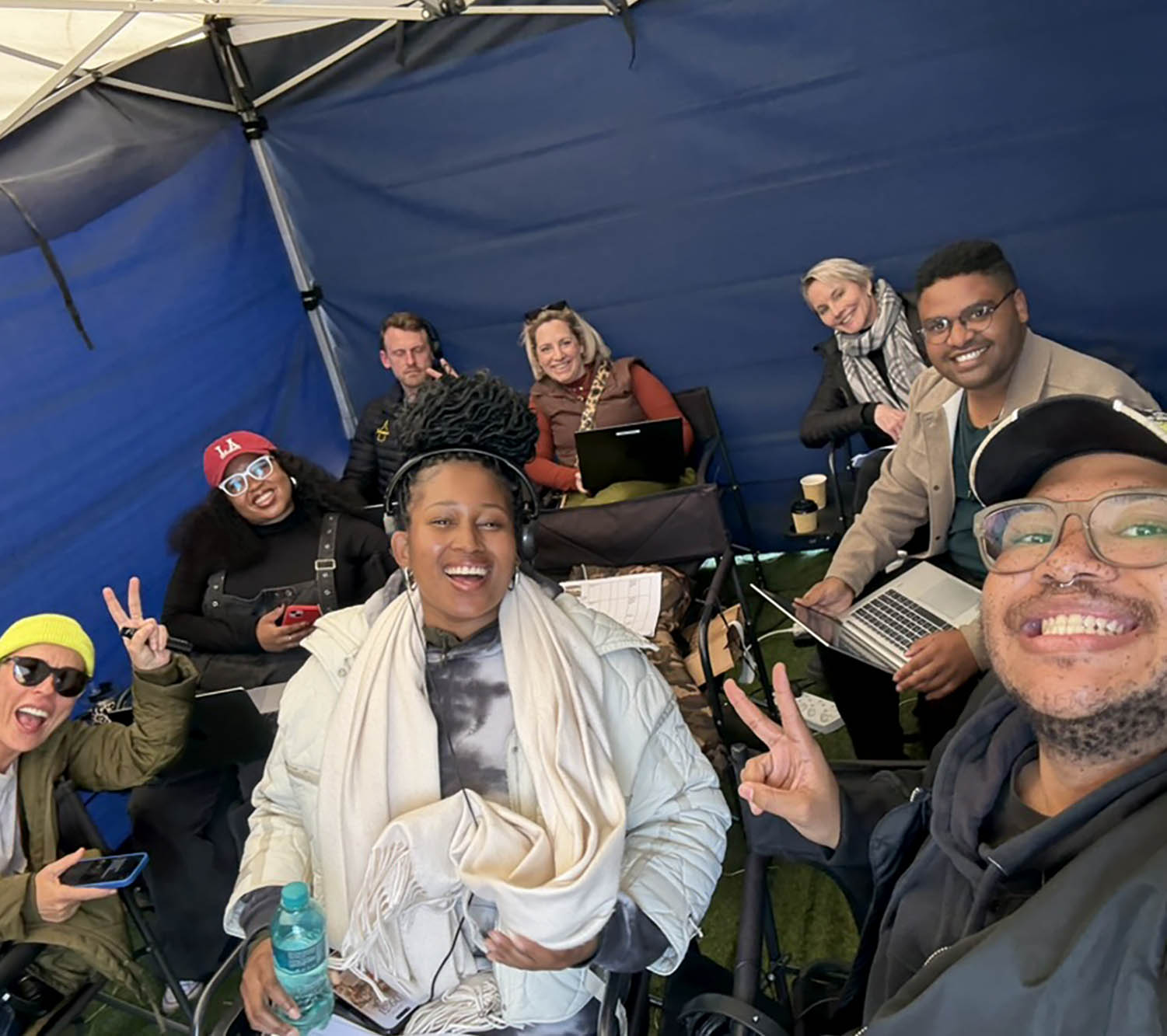


Top to BR: On the set of Savanna ‘Mozzies’ directed by Zee Ntuli from Darling Films.
Selfies with Nwabisa and her CD partner, Kevin Radebe. Last pic is one of their lizzard stand-ins that they affectionately named ‘NomaLIZo’.
Q: Has working across different cultural contexts changed the way you approach idea generation?
Nwabisa: The ad game in New York is not for the faint of heart. You have to love this work, because you often have to fight for it bright and early on a Monday morning after a weekend of grinding non-stop. So, I had to stop overthinking. Silly ideas don’t need to be hidden, just said out loud so you can open space to keep things moving.
Collaborating with Ava DuVernay’s team on Netflix’s ‘Colin in Black & White’ promo reminded me that storytelling carries responsibility. When culture is involved, nuance isn’t optional, and when Ava is reading your script, you gotta make it count. Working on projects like this, especially in a culturally sensitive country like the U.S., taught me the discipline required to create ideas that resonate at scale whilst acknowledging the weight of the subject matter. There is very little room for indulgence, every word must earn its place.
Colin In Black & White – ‘The Path is Power’ Official Teaser
Nwabisa worked on this while freelancing as a Creative Director at Netflix.
As ACD on Optimum Nutrition, after winning the business across Europe and North America, that experience strengthened my strategic approach. I went from being a creative who just wanted to make cool stuff, to being a problem solver who approached each brief with curiosity. Because no matter who we were communicating with, in any country, good ideas don’t survive without strong foundations.
Optimum Nutrition


Nwabisa worked on the Optimum Nutrition account while at TBWANEBOKO.
All that being said, returning to South Africa reawakened something else in me… humour. I’ve always been comfortable moving people emotionally. Making people cry is easy. Making them laugh? That’s craft. Working on a brand like Savanna, with wit at the centre of its identity, has stretched me in the best possible ways.
Q: What are some noticeable differences in the creative process across markets?
Nwabisa: A brief is a brief. So the difference isn’t really in the creative process, but rather what the team deems most important in that process. In many global markets, craft is non-negotiable. There’s a shared understanding that great work takes time, rigour, and collaboration.
What South Africa has, and what I’ll champion until the cows come home, is cultural texture. Our humour, our languages, our contradictions. You can’t manufacture that, and bringing that through in our copy and visual language tends to take precedence.
When you combine world-class craft with that kind of authenticity, the work becomes very difficult to ignore. And that’s the sweet spot I always strive to reach.
Q: When selecting directors, what signals tell you someone is the right partner?
Nwabisa: Curiosity. The best directors don’t just protect the script, they expand it. They bring perspective you couldn’t have arrived at alone.
I look for people who are confident enough to challenge the work, but humble enough to serve it. Red flags tend to be the opposite – defensiveness, ego, or a lack of curiosity. Collaboration requires openness and vulnerability.

In San Francisco with colleagues, Paul Rice, Anthony O’Neill, and students in The Academy at Goodby, Silverstein & Partners
Q: Having worked on globally awarded campaigns, how do you decide when an idea is worth pushing hard for?
Nwabisa: If it scares me a little but feels undeniable, I push. Fear is often a signal that you’re approaching something original.
I also ask myself a very honest question, “Would I be proud to have this represent my taste?” Awards are wonderful, but pride lasts longer.
Even when ideas don’t make it to the final stages of the process, anything that I felt passion for, I keep in my back-pocket and try again when the appropriate opportunity arises – could be on a different brief or a completely different client.
I also fight for ideas when the team I’m leading seems to see something I don’t. I trust the people I work with, therefore I stay open. Great advertising only happens when teams feel safe enough to experiment, fail occasionally, and try again.

Standing in front of the Goodby, Silverstein & Partners building. At this point, Nwabisa had already worked for the agency for over a year, but not yet in person because of the pandemic.
Q: What have global teams taught you about craft?
Nwabisa: That it’s an act of respect. Simply put, craft declares that the audience matters enough for us to obsess over the details.
Whether writing something playful for Cheetos or shaping something that carries more weight, I learned that refinement is how good ideas become unforgettable ones – one painful decision at a time.
Q: Are there habits or rituals you rely on when you feel stuck?
Nwabisa: I go back to people. I watch how they move through the world because human behaviour will give you the most truthful insights and solutions. I start conversations and eavesdrop on ones I have no business in.
And sometimes, stepping away feels productive. Clarity has a funny way of arriving when you stop chasing it.
Also, TikTok. Always TikTok.
Q: What do you look for in collaborators, and what are early red flags?
Nwabisa: Emotional intelligence is underrated in our industry. The strongest creative partnerships are built on trust, the ability to disagree without destabilising the relationship.
Curiosity is another non-negotiable. Nobody knows everything, and the sooner we admit that, the more expansive the work becomes.
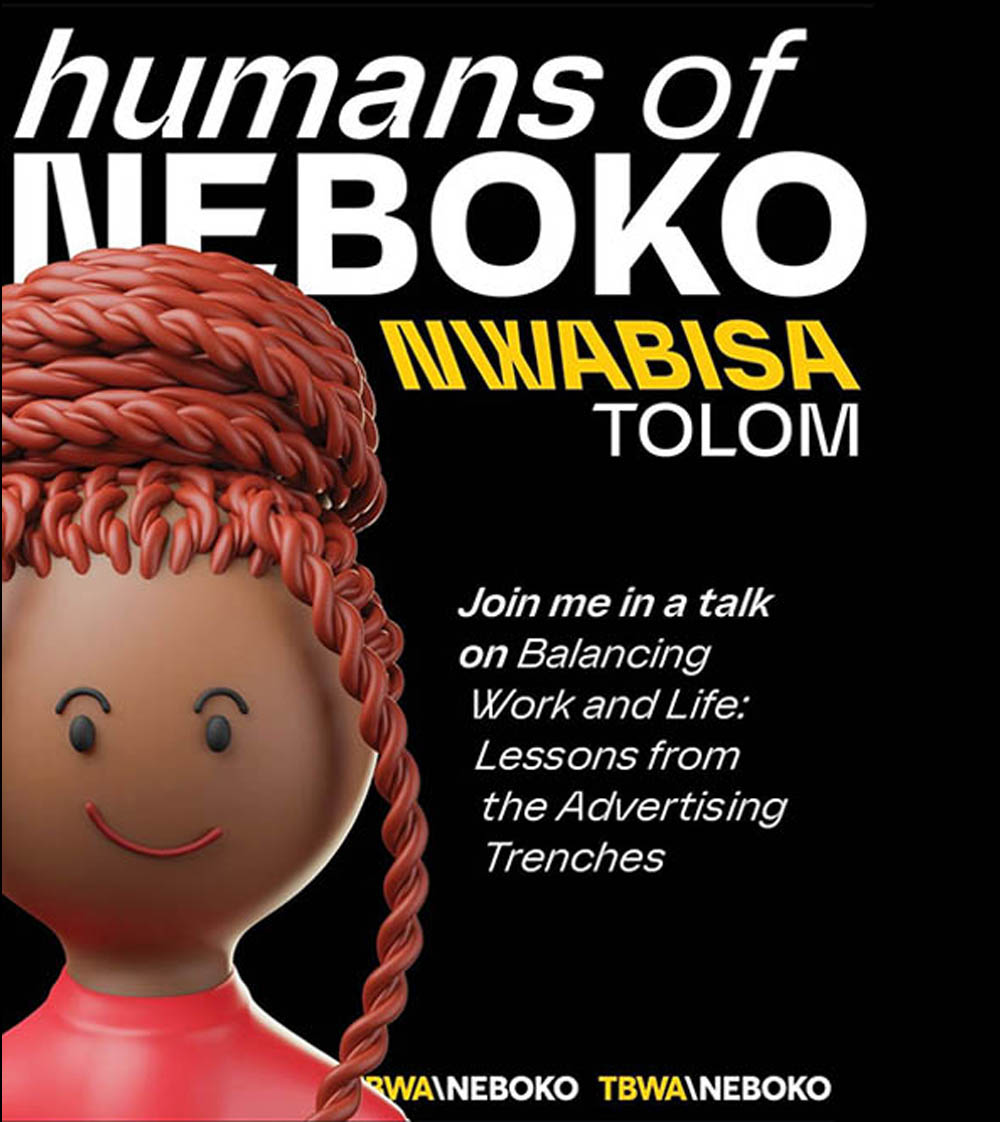

Humans of Neboko was the theme of Ad Night 2023 at TBWANEBOKO (Amsterdam) where Nwabisa was asked to speak. Her topic of choice was work/life balance.
Q: Can you think of a project where collaboration fundamentally shifted the idea?
Nwabisa: Every piece of Adidas work I’ve ever been part of has reshaped how I think about collaboration.
I first worked on the business at Johannes Leonardo in New York, partnering with teams from across the world to build ideas at true global scale. These are not fast projects (some take months, even years) and during that time you’re working with a vast ecosystem of talented people, each bringing a perspective and, quite naturally, a desire to leave their signature on the work. It becomes an ongoing exercise in listening, negotiating, and evolving your own ways of working.
Adidas ‘You Got This’
Years later when I joined the brand again at TBWANeboko in Amsterdam, our role was to develop the larger global platforms and then brief local markets to interpret them authentically. That process required more than logistical collaboration, it demanded strategic nuance and a deep sensitivity to tone, culture, and context.
As a writer, your instinct is often to protect the purity of the idea. Adidas taught me the value of letting go, of trusting external partners, and recognising that great global work isn’t diminished through collaboration, it’s strengthened by it.


Adidas Women’s Basketball campaign (featuring Candace Parker, Kahleah Copper, Chelsea Gray, Aaliyah Edwards, Aliyah Boston, Neeka Ogwumike, and Satou Sabally) that Nwabisa worked on at TBWANEBOKO.
It’s also a uniquely cultural brand. Whether working on Adidas Originals or sport, I quickly realised that the audience isn’t separate from the process, they are part of it. When a brand lives inside subcultures on the ground, the histories and experiences of the people wearing the brand inevitably shape the message. In many ways, the consumer becomes a collaborator. That’s when the work stops being communication and starts becoming culture.
Q: Now that you’ve circled back to Joburg, what excites you about making work here?
Nwabisa: At this stage in my career, I’m less interested in making noise and more interested in making work that leaves a mark. On culture, on people, and on the teams creating it.
I am equally energised by leadership. Growing talent is not separate from the work; it is how the work gets better. When people feel supported, they take braver swings that produce iconic outcomes.
I’m also excited to be creating in a world I understand instinctively. Home is home. It is where my deepest and most honest insights come from. There is a fluency you cannot manufacture when you are speaking to your own people.
South Africa is a uniquely fertile market for communication. The rigid rules that often govern agencies in Europe and the U.S. simply do not hold the same power here. We are more flexible, more playful, and often more willing to take risks. That openness creates space for work that feels alive.

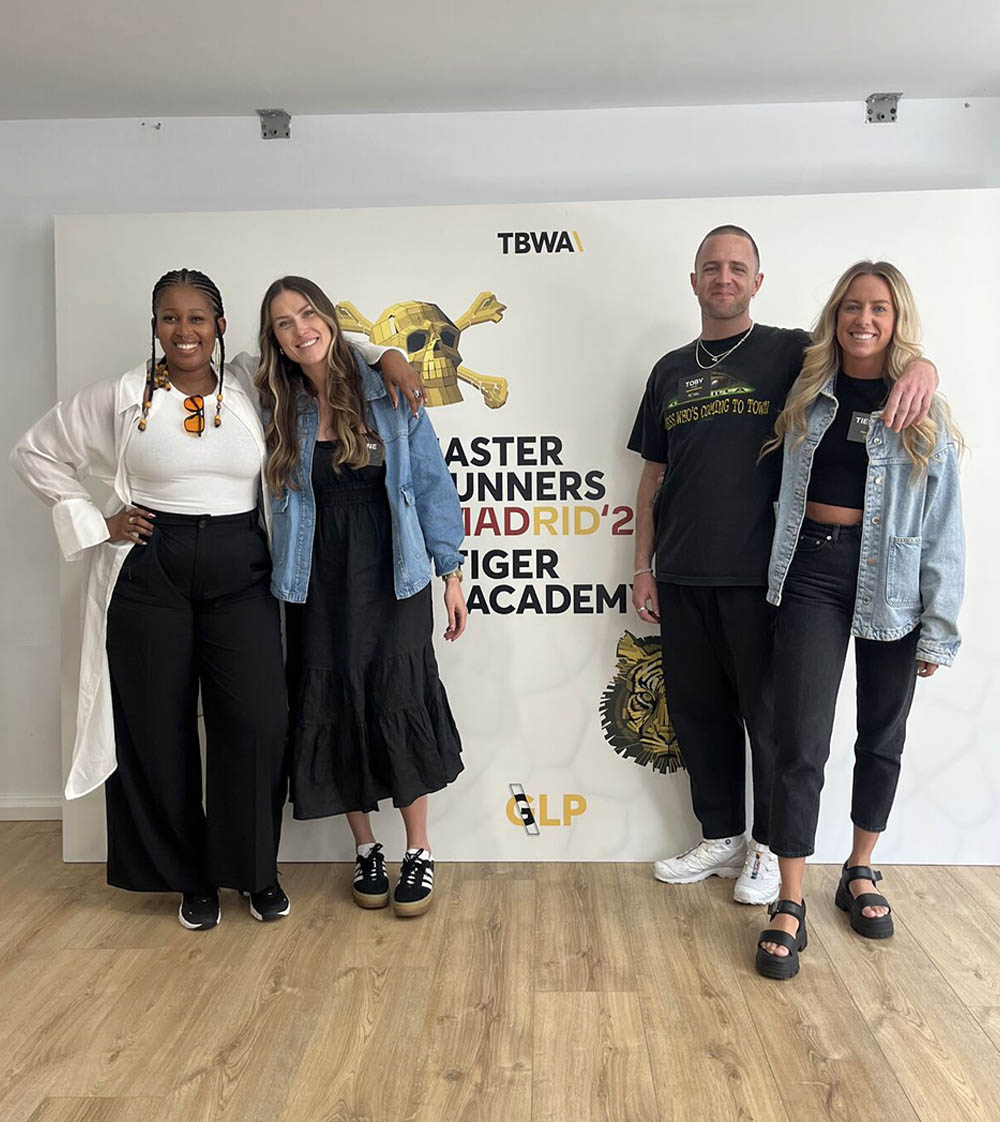
Master Gunners is TBWA Worldwide’s creative leadership programme. Whilst at TBWANEBOKO, Nwabisa was selected to participate alongside another colleague in creative and two others in account management who took part in Tiger Academy. This was in Madrid.
Q: What’s one piece of South African work you wish you’d done?
Nwabisa: As a Creative Director on Savanna, I promise this is not shameless brand loyalty talking, but honestly, the classic Savanna ads many of us grew up watching are hard to beat.
Savanna ‘Are Those Jack Russels?’
They were a masterclass in restraint. Beautifully simple, sharply observant, and unmistakably South African, yet never so insular that the humour could not travel. That balance is incredibly difficult to achieve.
What I’ve always admired is their intelligence. Even as a child (I’m very aware that I was absolutely not the target market) I understood why they were funny. Revisiting them as an adult, you start to see the layers. I admire the discipline it takes to land a joke without over-explaining it.
The thing about good comedy is that it looks effortless. It almost never is. Those ads did something else that I think our present-day industry can do more of. They trusted the audience. They did not shout for attention or rely on massive budgets. They simply presented a sharp human truth and let you arrive at the punchline yourself.
Now I have the privilege of helping carry that legacy forward. How unreal is that?!


Nwabisa’s dog, Yoshi, who has lived with her across 3 continents. ‘He’s my bestie and longest standing art director,’ she says.
Q: If you could speak to your junior copywriter-self, what would you say?
Nwabisa: Do it scared.
Early in my career, I underestimated my own voice. Many of us do before we realise the industry does not need replicas, it needs perspective. And every person has one, crafted by our unique lived experiences. And it’s incredibly valuable stuff when you have the gift to put it into words.
I would tell her to trust her instincts sooner, move past her mistakes faster, and stop shrinking to fit rooms she already earned the right to be in. I would tell her to keep writing. Especially on the days it feels most difficult. Those are usually the days you get closer to your truth.
Finally, I would tell her to take more risks, because the courage to move forward despite fear would take her further than she could imagine. It would carry her across continents, into rooms she once only encountered in awards annals, and lead to being mentored by people she had long admired from a distance
P.S. My biggest flex is having a direct line to Jeff Goodby, who taught me, among other things, that growth rarely asks for readiness, it’s all about movement.
Q: Spill – what is the real impact of AI on copywriting?
Nwabisa: As an industry, we’re at an interesting turning point.
AI is already changing copywriting in very real ways. At its best, it is a powerful support tool. But when it becomes a substitute for thinking, the work quickly loses clarity, tone, and human connection.
It is also shortening the distance between brief and execution and because of that it’s putting pressure on roles, particularly at junior levels. That uncertainty is real, and it would be dishonest to pretend otherwise. When technology can generate language and imagery in seconds, it forces our industry to confront what it truly values. Efficiency is no longer the differentiator. Judgment, taste, discernment are.
These are all things that AI can’t replicate. It can’t sense when a line will land differently in Soweto than it does in Soho, and it can’t take responsibility for the social impact of the work it puts into the world.
AI can accelerate the process, but it cannot replace that instinctive shift in the room when everyone recognises you have something good. And that human recognition, curiosity, passion to push boundaries, and doing it despite fear still sits at the heart of great copywriting.
Produced by the IDIDTHAT Content Studio
Credits: Anne Hirsch / Julie Maunder
This content is the property of IDIDTHAT.co and may not be reproduced in any form without prior written consent. All reprints must credit IDIDTHAT.co as the original publisher and include a direct link to this site.
If you’d like us to create editorial content, help you strategise your publicity, or put your work in the spotlight, get in touch. Explore our editorial packages or contact julie@ididthat.co Let’s get your work seen. #Boom